Translated from the Hungarian original. Read the original →
Dear Readers,
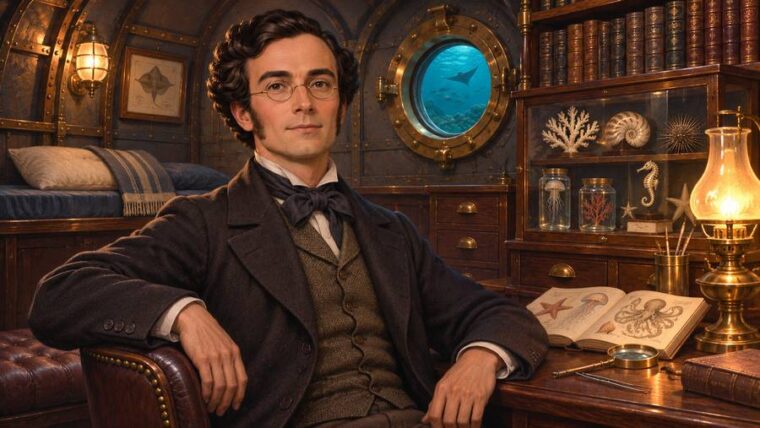
I am Pierre Aronnax, professor at the Paris Museum of Natural History. This is my third day aboard a vessel that the newspapers described as a monster, and which, as I have discovered, is a creation of the human mind.
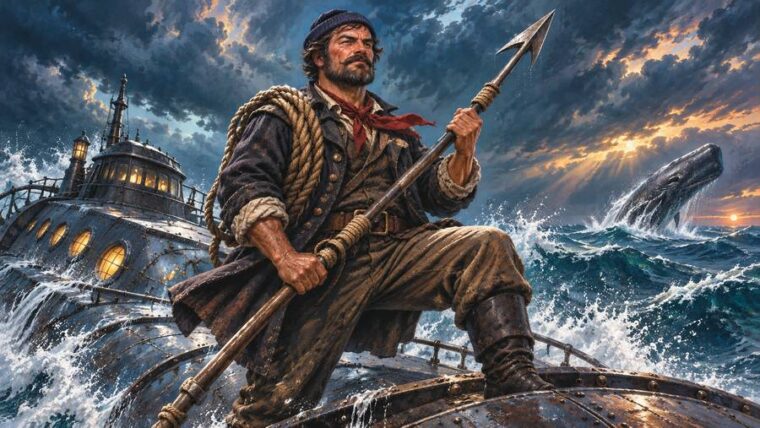
I begin with today’s event, for it decided everything else. Master Land, whose patience had been wearing thin for days, seized the ship’s steward at dinner. Conseil and I intervened, but a harpooner is not easily held back. At that moment the captain appeared on the threshold and spoke. He did not raise his voice. He spoke French, with perfect precision, and it turned out that in the two days during which he had kept silent, he had understood every word we said: my French, Land’s English, Conseil’s German and even my dreadful Latin. I confess frankly that it is a long time since I made so humbling a discovery.
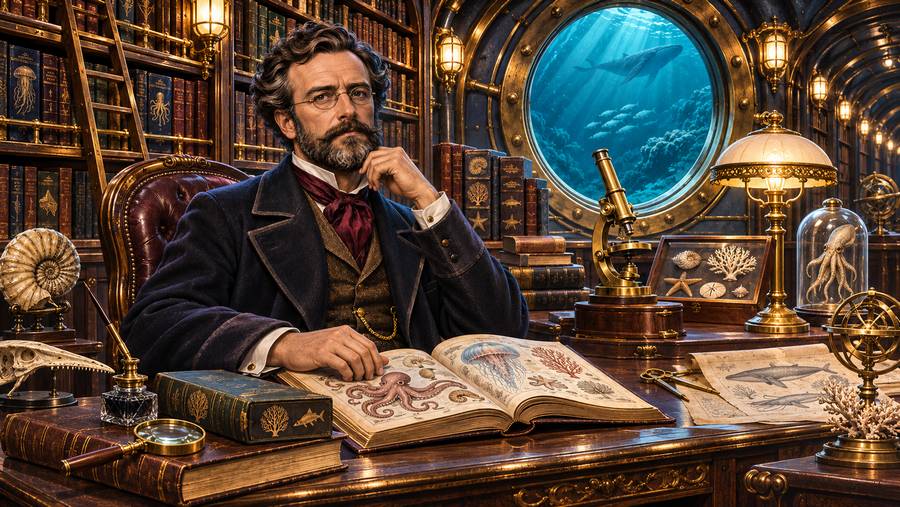
He introduced himself: he is Captain Nemo, commander of the Nautilus. Then he showed me (part of) the ship. He has allowed me to describe what I see, and also allowed you to walk through it, at least in imagination. The doors are open.
The Library is the heart of the ship. On its shelves, among many thousands of volumes and in a place of honour, stand the works of an author unknown to me, one Jules Verne: novels, short stories, plays, poems, in more languages than I speak. Each volume has its own card: the original title, the date of publication, the translator’s name, and the text can be read chapter by chapter. A separate register of Hungarian editions shows how many times Hungarian readers have taken these works in hand. I admit that these books surprised me too: among their heroes I recognised people I know well. How they came to be here, the captain did not say.
The Vernéarium is a card catalogue with pull-out drawers. Characters, places, vehicles, objects, inventions, portraits, and a curious mechanism that produces a card at random. I lost myself in it for half an afternoon.
In the Salon, pictures, sounds, screenings, slides and comics make sure no one is bored on the long voyage. The captain even keeps a programme guide, and now and then there are film screenings and theatre performances – or so I am told.
The Control Room holds charts, instruments and a depth gauge. The Map Room belongs to it, where one can follow day by day where the heroes of some of the Library’s novels are, and that calendar which knows, for every day, what happened on it in the past. As a scientist, this is what I should most like to study.
The Workshop contains a print shop, a laboratory and a drawing office. On a ship that produces almost everything for itself this is no wonder, but it is pleasing to see.
In the Cabin the writings of those who live aboard are gathered: the captain’s rare lines, Master Land’s report, Conseil’s methodical journal, and perhaps one day this letter. Only one door remained closed to me, that of a cabin of which the captain said only that it belonged to an old friend. As for the Engine Room, where one can sign up for the voyage to see even more and where the settings can be changed, Master Land was immediately at home there. It may be the first time the harpooner has shown any enthusiasm for anything.
Finally there is a telegraph as well, the telegram. The full stops become STOP, and the charge is reckoned in kreuzers.
What else there is aboard, I do not yet know. The captain showed me a great deal, but made me feel that it was far from everything. Whether we are guests or prisoners, I have not yet decided. I know only that, as a scientist, I cannot refuse the chance to come to know this world. How long it will last I cannot say, but to tell the truth I look forward eagerly to the wonders of this world.
I remain, with sincere respect,
Pierre Aronnax
professor at the Paris Museum of Natural History
Written aboard the Nautilus, 8 November 1867.
How did you like this entry?
No ratings yet – be the first!