Translated from the Hungarian original. Read the original →
The development of the Rouquayrol–Denayrouze apparatus and its significance in the history of diving technology
For centuries, breathing under water was one of the greatest technical challenges facing human ingenuity. Until the middle of the 19th century, divers’ freedom of movement was limited above all by the fact that the air they needed had usually to be supplied from the surface, through hoses. Although the heavy diving equipment of the time already allowed longer work under water, the diver still depended on an air supply from the surface. It was in this technical setting that the Rouquayrol–Denayrouze apparatus was born in the 1860s, its most important innovation being an automatic air supply that followed the diver’s inhalation. The invention not only marked a turning point in the development of the diving equipment of its day, but also became one of the direct technical forerunners of modern self-contained breathing apparatus.
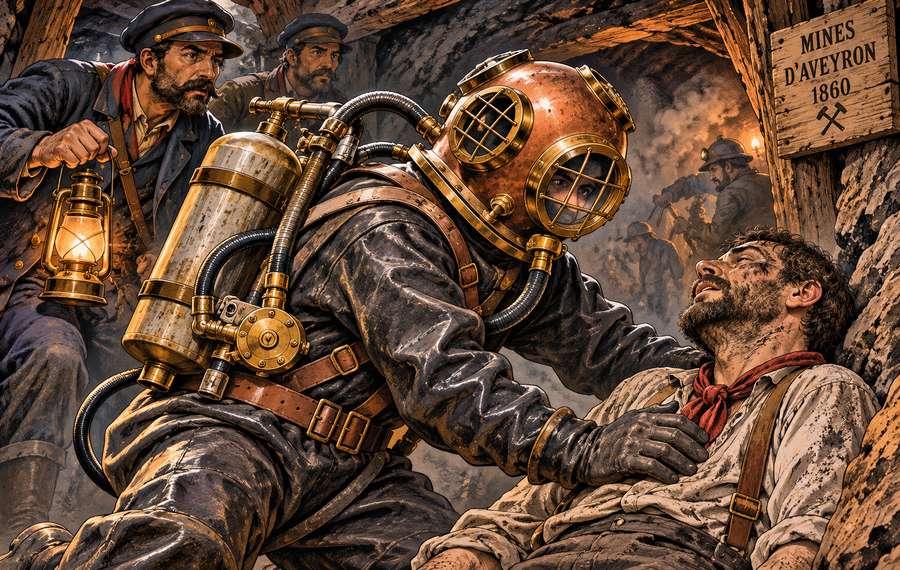
Surprisingly, the apparatus’s story begins not at sea but in French mining. Benoît Rouquayrol (1826–1875), a mining engineer, worked in the coal mines of the Aveyron, where mine fires, poisonous gases and explosive methane were a serious threat. Mine rescuers needed equipment that would let them work in an unbreathable atmosphere. Rouquayrol therefore set about developing a portable breathing apparatus worked by compressed air.
The first decisive result came in 1860, when on 14 April Rouquayrol patented his device for regulating the flow of compressed gases. The invention was based on an automatic regulator that released air from the tank not continuously but according to the user’s breathing needs. This solution was especially important because it reduced the waste of air and allowed the available supply to be used more economically. On 16 January 1862 Rouquayrol filed another patent: the “Rouquayrol isolator”, consisting of a regulator and a breathing mask covering the nose and mouth; and on 25 August 1863 he also patented the pump needed to compress and deliver the air. These developments gradually made it possible to use the device designed for mine rescue in other environments too, including under water.
The next important figure in the story is Auguste Denayrouze (1837–1883), a French naval officer. Denayrouze became a ship’s lieutenant in 1862 and took part in an expedition to Cochinchina (present-day Vietnam), where he fell seriously ill. As a result he temporarily left active naval service and convalesced in his home region of the Aveyron, at Espalion. There he became acquainted with Rouquayrol’s work and realised that the breathing apparatus developed for mining could also be used for diving. In the two inventors’ collaboration, Rouquayrol mainly provided the technical foundations and the solution to pressure regulation, while Denayrouze played a decisive part in defining the practical requirements of use at sea, in further development and in spreading the apparatus.
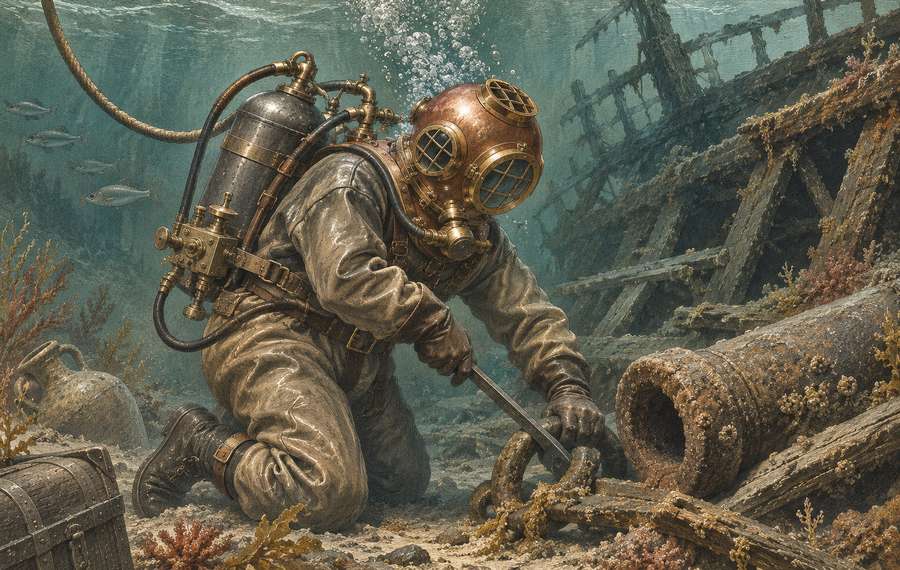
The collaboration led in 1864 – on 27 June, according to some sources – to a further patent, which now covered solutions specifically for protecting divers and enabling them to breathe under water. Thus was born the diving breathing apparatus known as the Rouquayrol–Denayrouze. Its most important element was an automatic breathing regulator connected to a compressed-air tank – an early ancestor of today’s diving regulators.
The regulator worked on a relatively simple yet extremely ingenious mechanical principle. In the device, a flexible diaphragm sensed the change in pressure produced by breathing. When the diver inhaled, the pressure in the regulator chamber fell, causing the diaphragm to move and open a valve. Compressed air then flowed from the tank into the breathing circuit. As the pressure equalised, the valve closed again. The system thus supplied air automatically, in step with the diver’s own breathing, while matching its pressure to that of the surrounding water. This was of fundamental importance, since under water the external pressure rises with depth, so the diver must breathe air at the appropriate pressure.
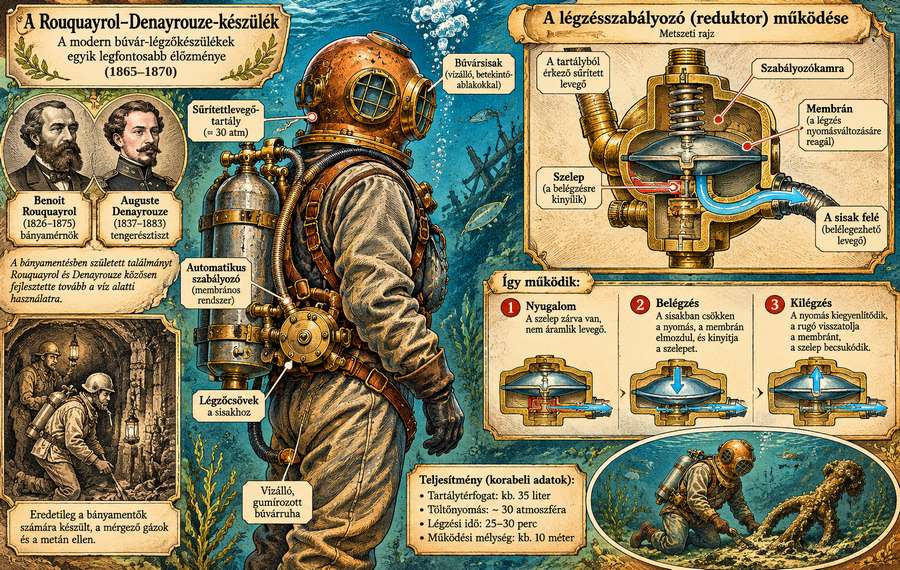
Several versions of the apparatus were made. One type received its air from the surface by means of a pump, while the tank on the diver’s back served as a buffer and reserve. In the other, higher-pressure version, the air stored in the tank also allowed breathing independently of the surface for a shorter time. Fully autonomous operation, however, was limited by the small capacity of the tanks of the day and the relatively low pressure that could be used. The more powerful versions – according to some sources with a thirty-five-litre tank filled to thirty atmospheres – could provide, under favourable conditions, roughly 25–30 minutes of breathing at a depth of about ten metres.
During development, not only the air supply but also the diver’s protection and orientation under water had to be solved. The inventors experimented with waterproof rubberised diving suits, breathing tubes and various kinds of head protection. The copper mask developed in 1865, which because of its characteristic shape was known in French diving jargon as the groin, or “pig’s snout”, protected the face directly and had viewing windows. The mask, however, did not prove suitable in all conditions. On the basis of practical experience the designers returned – from 1866 – to the more traditional heavy diving helmet enclosing the whole head, which they connected to their own air-regulating system. According to some sources a three-bolt diving helmet was already among the developments of 1867; other sources date the Denayrouze three-bolt helmet to 1873.
The development of the Rouquayrol–Denayrouze apparatus thus gradually continued in two directions. On the one hand, the principle of the compressed-air tank providing for autonomous breathing and of the automatic regulator was retained; on the other, the surface-supplied versions were adapted to the demands of professional diving work. Equipment supplied from the surface allowed longer periods of work, and so in practical use it became more important than the fully autonomous versions with their limited endurance.
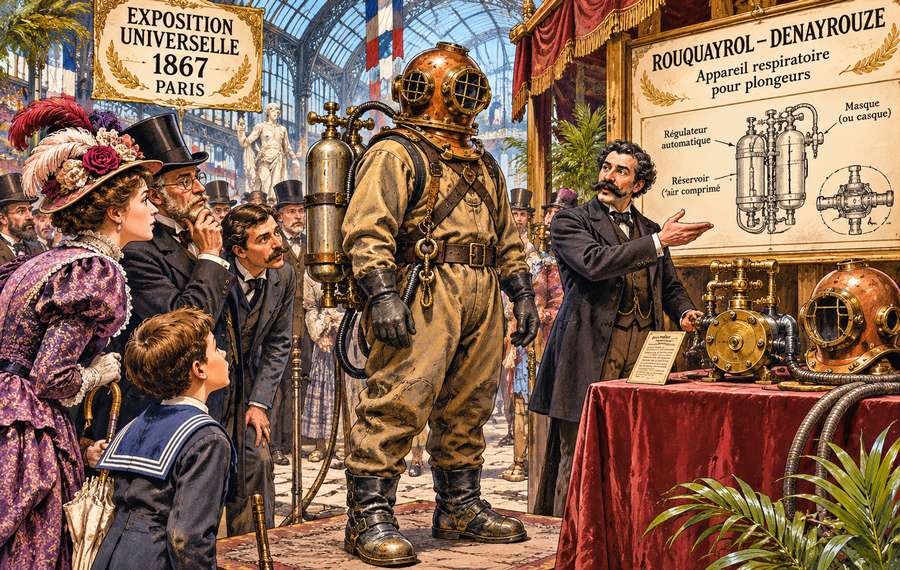
International recognition came with the Paris Exposition of 1867, where the apparatus won a gold medal in the diving equipment category. The success helped its commercial distribution and made the Rouquayrol–Denayrouze name known beyond Europe. Various versions of the system were used by navies, in underwater construction, ship maintenance and other industrial work.
Could Nemo, Aronnax and Conseil have survived the hunting trip at Crespo Island?
How long can the diver last? · Twenty Thousand Leagues Under the Seas
This is what this little game, or experiment, tries to show: by adjusting various parameters you can change the “efficiency” of the oxygen in the tank – and of course there is a “secret weapon”, the box of caustic soda, which absorbs the exhaled carbon dioxide that could even be life-threatening! (The size of the tank is not specified in the novel, so it can be adjusted; we do not take other effects into account, such as nitrogen narcosis…)
(to be continued)
How did you like this entry?
No ratings yet – be the first!