Translated from the Hungarian original. Read the original →
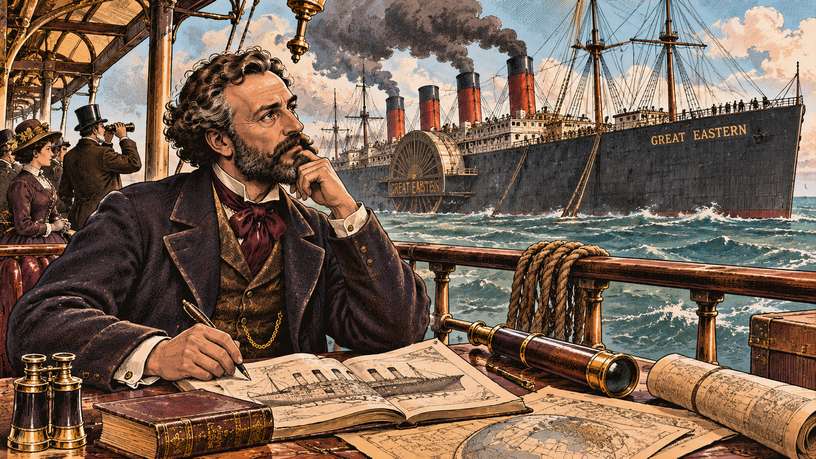
As in many of his other novels, the author strives here to make the story as believable as possible, making it fantastic only as far as is strictly necessary. One means to this end is drawing real people and events into the plot. It is no accident that the world truly takes notice only after the Scotia’s accident. At the time the novel was written and set, the Scotia was the fastest passenger liner, holding the Blue Riband for the Atlantic crossing in both the eastbound and westbound directions. The ship did indeed belong to the Cunard Company mentioned in the novel, which was then regarded as one of the most famous and safest shipping lines. Visits to famous shipwrecks, each a link with the real world, could serve the same purpose, as could the discovery of the transatlantic cable. That cable was laid by the Great Eastern, on which Verne himself had travelled – in the early period of writing the novel, when he was presumably also gathering material. All this naturally served entertaining popular science too.
In 1866 the newly appointed admiral of the US Navy was David Farragut. He was then considered the most famous American seaman; at the time of the story he was in reality in command of the European Squadron, his flagship the USS Franklin, and he was approaching seventy. The European public hardly knew the details, so readers could easily believe that the captain of the warship in the story was the same man, or perhaps one of his descendants. The novel’s commander was probably given the name Farragut because it sounded good.
And while we are on the warship: in several of his novels Verne pays tribute to President Lincoln, whom he greatly admired and who was assassinated in 1865 – here he named the warship that attacks the submarine the Abraham Lincoln.
Another thing worth mentioning is his attitude to the English: partly because he was French, he was decidedly not fond of them, yet he also admired them, since the British Empire was then at its height under Queen Victoria. A few years earlier Verne had travelled in the British Isles and watched the technical progress there with fascination. Traces of all this can be found in the novel: he acknowledges the superiority of the Cunard Company over French shipping, calls the English the most skilful people on earth, and through Aronnax and Nemo speaks with particular respect of the great explorers, among them James Cook.
Ferdinand de Lesseps is also mentioned several times in the novel, among other things as the designer of the Suez Canal. Verne genuinely held the French diplomat in high regard, as the words of Aronnax and Nemo also show. The esteem may have been mutual, for it was on Lesseps’s recommendation that Verne received the Legion of Honour after the novel was published.
The American oceanographer Matthew Fontaine Maury comes up several times as well; Verne surely knew that he was of French descent, and Maury did indeed chart the world’s seas, winds and currents, collected samples from the deep sea and carried out all kinds of experiments.
The novel is set, in principle, between 1867 and 1868, but there is some uncertainty about the dates.
The narrator is a French scientist named Pierre Aronnax, and what we read is in effect his journal. From it we learn that the events begin on 20 July 1866 with the case of the Governor Higginson, but the real action only starts on 2 July 1867, when the American warship sets out to find the mysterious monster. Aronnax, his servant Conseil and a Canadian harpooner, Ned Land, join the expedition. After a series of adventures, according to the journal, they manage to escape some time in June 1868 – Aronnax gives no exact date.
That the time spent on the Nautilus comes to only about eight months, while the professor consistently speaks of ten, may simply be a slip of the pen. But there are more serious problems too – though that will be the subject of another post…
Nemo also claims that he has no contact with the outside world. One might still believe this after the rescue of the pearl diver (since that was not a planned contact), but Nicolas, who turns up in the Greek islands, greets Nemo as an acquaintance and is not frightened by the submarine, already shades the picture somewhat. As does the fact that he supports the freedom fighters with an enormous quantity of gold, which a few days later he replenishes in Vigo Bay – for he will still need it, as his words suggest. So he is not quite so cut off from the world after all.
The characters in the novel are exclusively men, which is no surprise given Verne’s other works, since women only rarely play important roles in his novels. Yet we are not left entirely without women: the paintings aboard the submarine depict countless women, from the Madonna to nymphs. Clearly the most important of them is Captain Nemo’s wife, whose portrait with her two small children hangs in the captain’s cabin beneath the pictures of the freedom fighters.
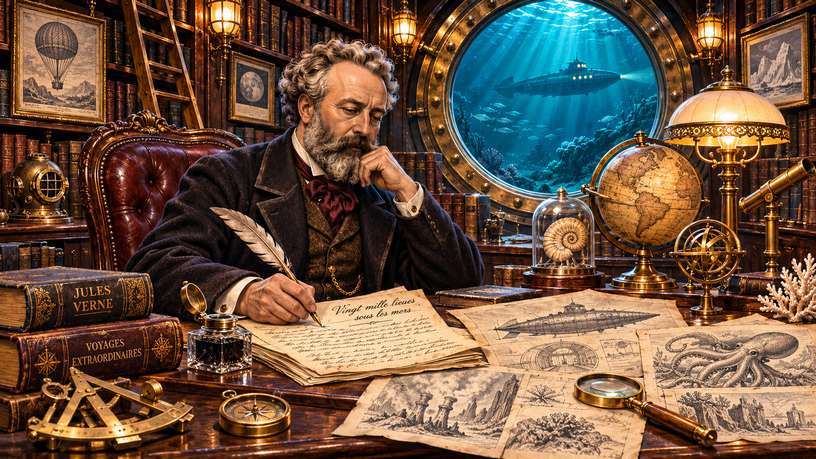
Be that as it may, the novel’s success is hard to dispute. A few decades after the book appeared, Verne was even accused of having bought the manuscript for 100 francs from Louise Michel, one of the well-known figures of the Paris Commune. 🙂
How did you like this entry?
No ratings yet – be the first!