Translated from the Hungarian original. Read the original →
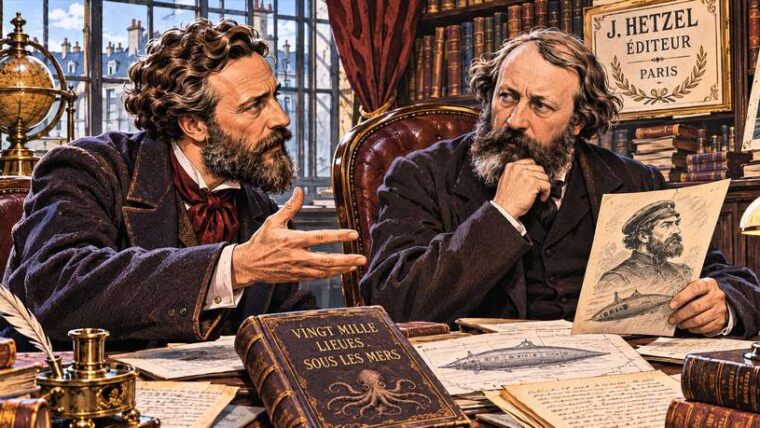
This is perhaps the most famous of Verne’s novels, written when the author was already celebrated as an established writer. It was completed after – and partly during – a handful of truly Vernian adventure novels (From the Earth to the Moon, Around the Moon, Journey to the Centre of the Earth, In Search of the Castaways and The Adventures of Captain Hatteras) and one real great voyage (to North America aboard the Great Eastern). It may be the one he worked on longest and hardest of all his great novels. Its title was originally to have been Le Voyage sous les eaux; the final title was chosen from several variants only in the spring of 1868, at Le Crotoy, aboard his boat – probably at Hetzel’s suggestion.

According to the sources, the basic idea came from a letter by a fellow writer, Amandine Aurore Lucile Dupin – that is, George Sand – dated 25 July 1865 (the author told this in an 1897 interview with Adolphe Brisson, and even showed the letter to his visitor). In it Sand praises Verne’s latest book and writes that she hopes he will soon take his readers down to the bottom of the sea and send his characters travelling in vessels that move beneath the waves; she adds that he has a great and charming talent, and a heart besides. Verne gave this serious thought and began gathering material as early as the summer of 1865, work that went on for years. The plans, at any rate, were soon ready: on 19 January 1866 he was already writing in a letter that the framework of the novel was complete. The first substantial reference to the story dates from August 1866, when he had just finished In Search of the Castaways: in a letter to Hetzel of 10 August 1866 he reports that the underwater voyage is also being prepared, and that he thinks he will use electricity, though this is not yet really decided.
A few days later, however, Théophile-Sébastien Lavallée fell seriously ill; Hetzel had been about to have him write an illustrated geography of France and its colonies. Of the already announced work Lavallée had written only the preface, so Hetzel entrusted the book to Verne, and it demanded a great deal of his time and hard work. The task finally took fifteen months, and Verne was longing to get back to his own story.
A few years earlier, Europe’s attention had turned to Poland: in January 1863 the Poles rose against their Russian oppressors to throw off the yoke, but the uprising was crushed with particular cruelty in May 1864. The event had a strong effect on the writer. In his original conception the hero was a Polish nobleman taking revenge on the Russians after the uprising was crushed, his family having been killed or exiled to Siberia, and his daughter raped by Cossacks.
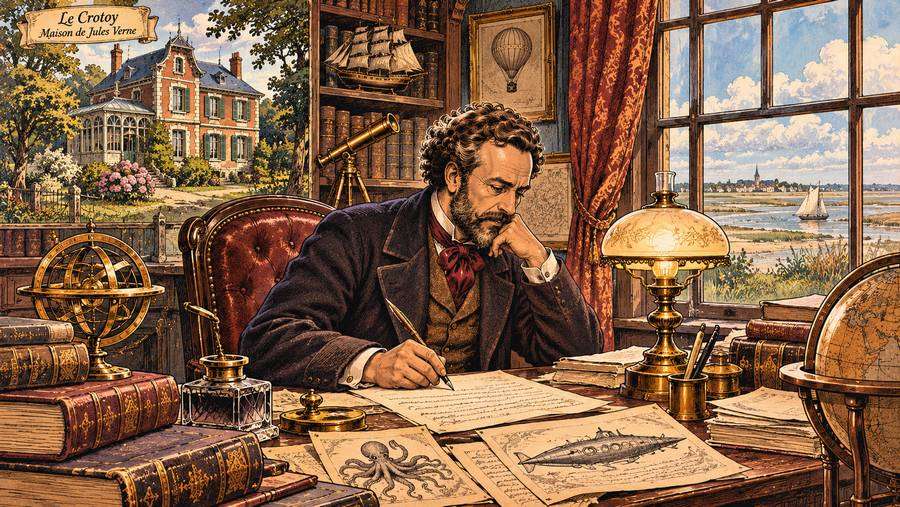
In August 1865 Verne decided to move to the seaside and rented lodgings at Le Crotoy. From March 1866 this was in the end one wing of the Château de Millevoye, where the family of the French poet Charles-Hubert Millevoye, who had died young, lived. His wife, two daughters and son could bathe freely while he worked on his novels and the geography book. In the spring of 1868 he rented a house (La Solitude – solitude), and in March 1869 he decided to settle there for good. So the novel was written largely in the villa La Solitude at Le Crotoy and aboard his yacht.
He wanted this book very badly: on 10 March 1868 he wrote to his father that he was working on it with enormous pleasure. So much so that by August 1868 he had already finished the first part.
According to the basic idea, a mysterious monster appears on the world’s seas, ships suffer one accident after another, until the American government sends an expedition to destroy it. The crew of the frigate Abraham Lincoln watched the sea like Argus (the image is Verne’s), but just as Argus failed to guard Io, the frigate failed to defeat the monster: the mysterious creature outwitted its pursuers. At the encounter the monster and the ship collided, and the three men who fell into the water – Professor Aronnax, his servant Conseil and Ned Land, the harpooner – ended up aboard a mysterious submarine, which was none other than the “monster” itself. After a few months of adventurous travel they finally escaped from the vessel.
Along the way they travelled almost all the way round the globe and reached the deepest point on Earth (greatly overestimating its depth, it is true, and not quite where it really lies), as well as the South Pole – since a few years earlier another Verne hero, Captain Hatteras, had explored the North Pole.
They also reached places whose existence has still not been proved – the ruins of Atlantis in the Atlantic Ocean, or the Arabian Tunnel between the Red Sea and the Mediterranean – and which perhaps do not exist at all.
By then there had already been quite a few attempts – mostly, alas, unsuccessful or of little success – to build and operate submarines. Once again Verne did what he did so often: he took existing inventions further, coloured them with his imagination and invented a story around them.
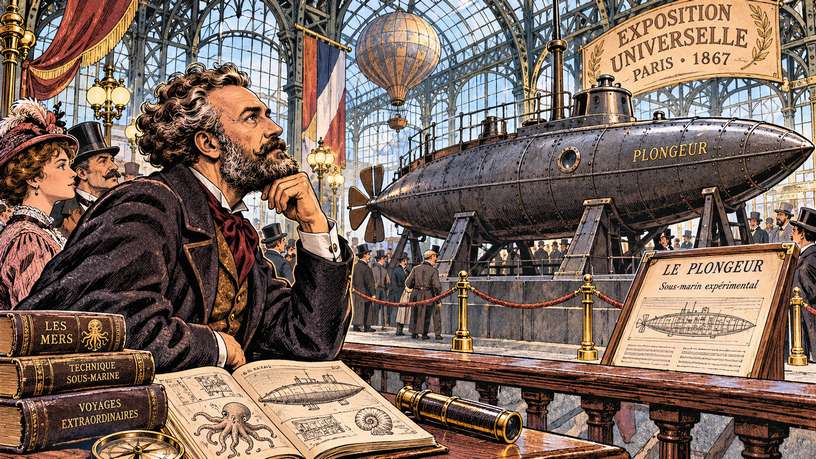
He argued constantly with his publisher about the story, but the subject enchanted him too: on 28 March 1868 he wrote to Hetzel that he had never had a finer subject in his hands. Hetzel did not yet want to close the story; he would have liked a third part as well (he refers to it in several letters, for example on 25 April 1869), with Ned Land as its main hero. But Verne dug in his heels. He also refused to have Nemo’s struggle reduced simply to hunting down slave traders: he intended a more complex aim for him. He wrote about the settlement of the last great dispute while the novel was already appearing, in a letter of 17 May 1869. Yet he felt that he had to give way as well. For the figure of Nemo the illustrators eventually took as their model Colonel Charras, who had died a few years earlier, an old friend and political comrade of Hetzel’s and a great supporter of the republic. Conseil was modelled on a French engineer, Jacques-François Conseil, whom the author met on a few occasions in the 1860s, perhaps became friends with, and who incidentally worked in the field of navigation. And the model for Aronnax was the author himself: Riou drew the professor from an 1868 photograph.
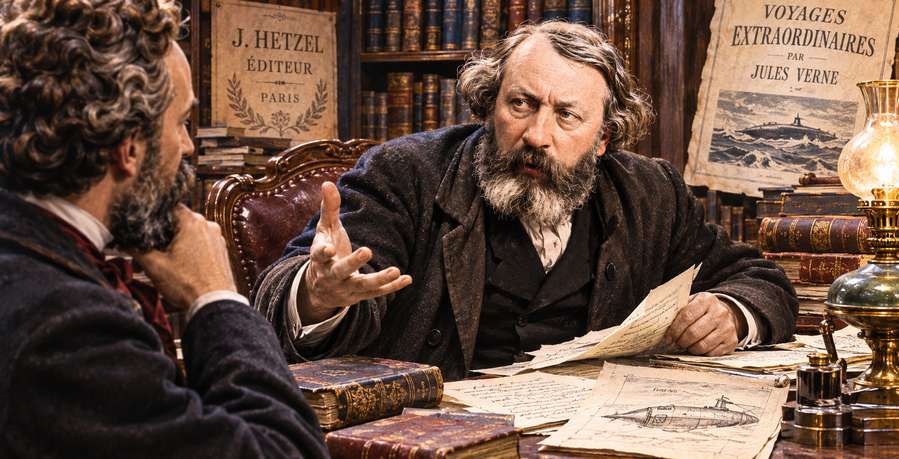
In the end the manuscript existed in two markedly different versions, which show clearly the struggle between publisher and author. In Hetzel’s view Verne should not deal with sexuality, violence or politics, and it was above all the last of these that became the breaking point. According to some plans, for example, the submarine would also have conquered the North Pole; but more interesting still is that Hetzel wanted a further volume in which only one character escapes and is then recaptured, and which would have made room for a rejection of slavery and the rescue of a Chinese boy. Verne turned these plans down.
Hetzel prepared the reading public well in advance for what lay ahead: in the 5 September 1867 issue of the Magasin he wrote that Verne was working on a most unusual story that would guide the travellers (and of course the readers) into the underwater world.
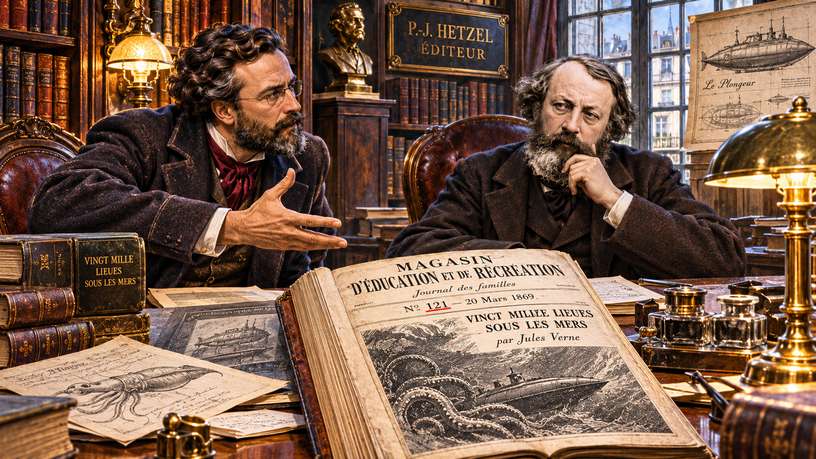
Hetzel’s magazine, the Magasin d’Éducation et de Récréation, finally began serialising the novel on 20 March 1869. For almost a year and a half the public received new instalments every fortnight, until 20 June 1870. Meanwhile the two volumes also appeared separately (on 28 October 1869 and 13 June 1870), and once the whole series had appeared they wanted to publish it in a single binding as well. Because this was the time of the Franco-Prussian War and then the Paris Commune, the complete edition did not appear until 16 November 1871. In the magazine the work appeared in text only, the volumes already had illustrations, and the complete edition became the traditional, richly decorated Hetzel volume. So keen readers wanted to obtain every one of them – which brought the publisher several times the income, and the author too, of course.
The first edition was printed in 50,000 copies and sold out in barely a week. The novel’s popularity carried it to the top of the bestseller lists, and its lasting success is shown by the fact that it has since been translated into 174 languages.
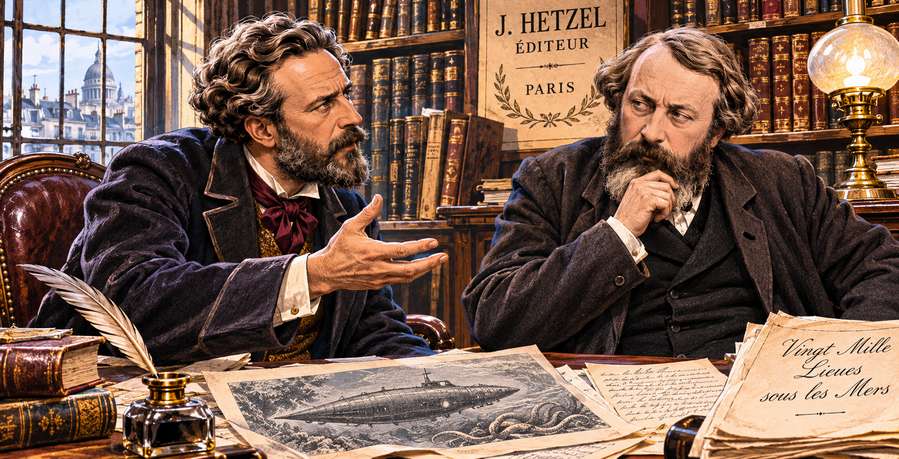
As mentioned above, Verne originally wanted to portray a Polish freedom fighter, but Hetzel talked him out of it for commercial reasons, and in the end he followed the advice. It was no easy argument: at first Hetzel thought he would easily persuade the author, who this time dug in his heels. It took a long time before he let go of an idea he had cherished for at least two years. Finally, in May 1869 (that is, while the novel was already being published), in the letter already mentioned, he wrote that he was giving up the idea of Nemo being a Pole – but in that case he would have no (known) nationality at all.
So the hero of the novel remained of unknown nationality. He had built a marvellously equipped, modern submarine that offered its passengers every conceivable comfort. He could live there without a care – and yet he cannot.
(but the story is not over yet)
How did you like this entry?
No ratings yet – be the first!