Translated from the Hungarian original. Read the original →
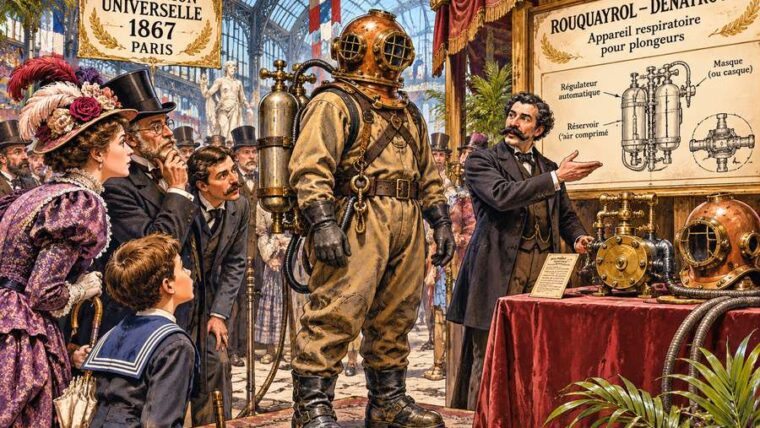
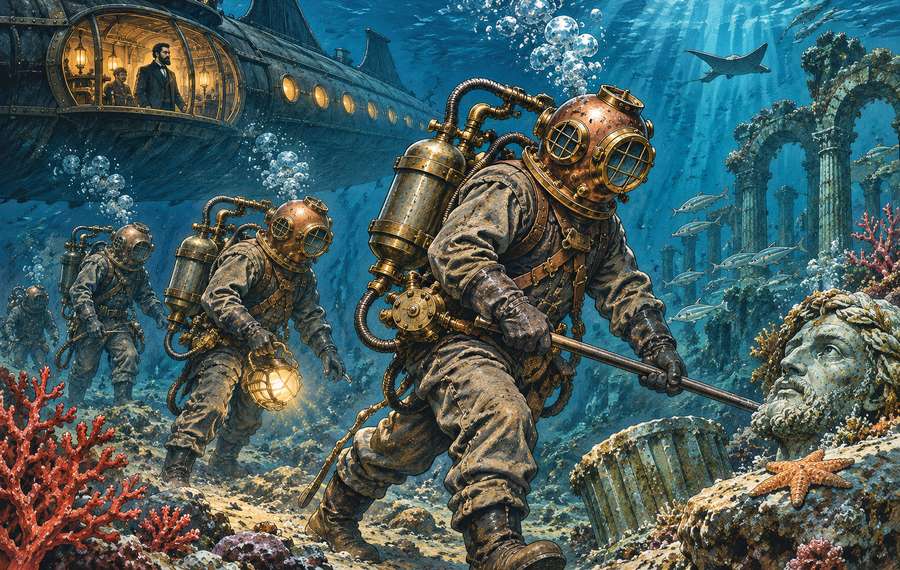
The invention also influenced the science fiction of the day. According to some sources, Jules Verne too visited the Exposition and discovered the apparatus with great enthusiasm. In his novel Twenty Thousand Leagues Under the Seas (French: Vingt mille lieues sous les mers; published in Hungarian as Nemo kapitány), which appeared in 1869–1870, he chose the Rouquayrol–Denayrouze breathing apparatus as the underwater equipment of the Nautilus’s crew, even naming the two inventors. In Chapter XV of the first part, Captain Nemo describes the apparatus in detail to Professor Aronnax, claiming to have improved it for his own purposes. The main aim of these modifications was to let divers move about safely for longer periods, independently of any air supply from the surface and at considerable depths.
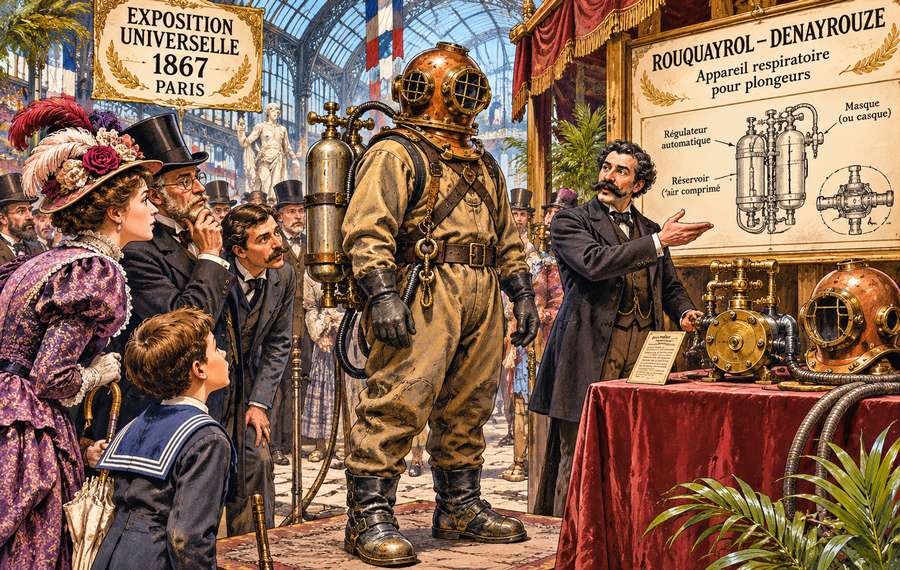
One of Nemo’s most important changes concerned the storage of air. According to the captain, the Nautilus’s powerful pumps compressed air to fifty atmospheres in the tanks of thick sheet metal carried on the divers’ backs. An automatic regulator attached to the tank delivered the air to the diver at the pressure needed for inhalation. The other essential change concerned the breathing mask. Nemo replaced Rouquayrol’s mouthpiece, which enclosed the nose and mouth, with a copper sphere enclosing the whole head, to which separate inhalation and exhalation tubes were connected. He explained that this was necessary because of the considerable water pressure at greater depths. The solution was not, however, an entirely new invention, since the heavy diving equipment of the day already used copper helmets, and from 1866 Rouquayrol and Denayrouze themselves developed their apparatus further in this direction.
The novel’s most remarkable technical claim concerns the endurance of the breathing apparatus. According to Nemo, air compressed to fifty atmospheres could keep a diver breathing for nine or ten hours. That would have been an extraordinary performance, since the endurance of the self-contained breathing apparatus of the time was usually much shorter. On this point, however, the technical credibility of the description is highly questionable. A tank of the period holding, say, eight litres would contain at fifty atmospheres roughly four hundred litres of air converted to surface atmospheric pressure. With moderate physical effort and a surface consumption of twenty litres a minute, this amount would give at most about twenty minutes of breathing even at the surface. At a depth of ten metres, where the ambient pressure is close to two atmospheres, this time would fall to about ten minutes. Yet in the novel the underwater walk descends to a depth of a hundred metres, where the pressure is already ten atmospheres – there the same supply would last barely two minutes. Nine or ten hours under water would therefore have required a far larger supply of air, a much higher storage pressure, or a rebreather that properly handles the exhaled gas.
Nemo’s claim is made no more credible by the fact that in the novel Professor Aronnax worries about the oxygen content of the air falling as it is used up. In an open-circuit compressed-air apparatus, the proportion of oxygen in the air remaining in the tank does not fall appreciably as it is consumed. If the exhaled air were reused, on the other hand, it would indeed be necessary to remove the carbon dioxide and replace the oxygen consumed. But Nemo describes no such system that would allow nine or ten hours of operation. The great power of the Nautilus’s pumps alone, therefore, could not have solved the problem of the portable tank’s limited capacity.
On this basis, Nemo’s modifications can be regarded as partly feasible technically, but partly over-optimistic. The use of a higher-pressure air tank, breathing regulation and the combination with a metal helmet protecting the whole head was a realistic engineering idea. The extremely long endurance and work at great depths free of any physiological risk, however, belonged to the novel’s fantastic elements. Verne’s merit lay precisely in imagining the future of underwater movement starting from a real invention, pioneering in its day. Nemo’s apparatus thus reflected both the actual achievements of 19th-century diving technology and technical possibilities that became achievable only much later.
Could Nemo, Aronnax and Conseil have survived the hunting trip at Crespo Island?
How long can the diver last? · Twenty Thousand Leagues Under the Seas
This is what this little game, or experiment, tries to show: by adjusting various parameters you can change the “efficiency” of the oxygen in the tank – and of course there is a “secret weapon”, the box of caustic soda, which absorbs the exhaled carbon dioxide that could even be life-threatening! (The size of the tank is not specified in the novel, so it can be adjusted; we do not take other effects into account, such as nitrogen narcosis…)
Although the Rouquayrol–Denayrouze apparatus represented a significant technical advance, it could not solve the problem of autonomous diving once and for all. The lack of sufficiently light cylinders able to withstand high pressure, the weight of the equipment and the limited air supply held back its wider adoption. The principle of automatic air delivery, however, proved lasting. Nearly eight decades later, in 1943, Jacques-Yves Cousteau and Émile Gagnan combined a more modern, reliable automatic regulator with high-pressure cylinders and laid the foundations of the modern open-circuit self-contained diving apparatus.
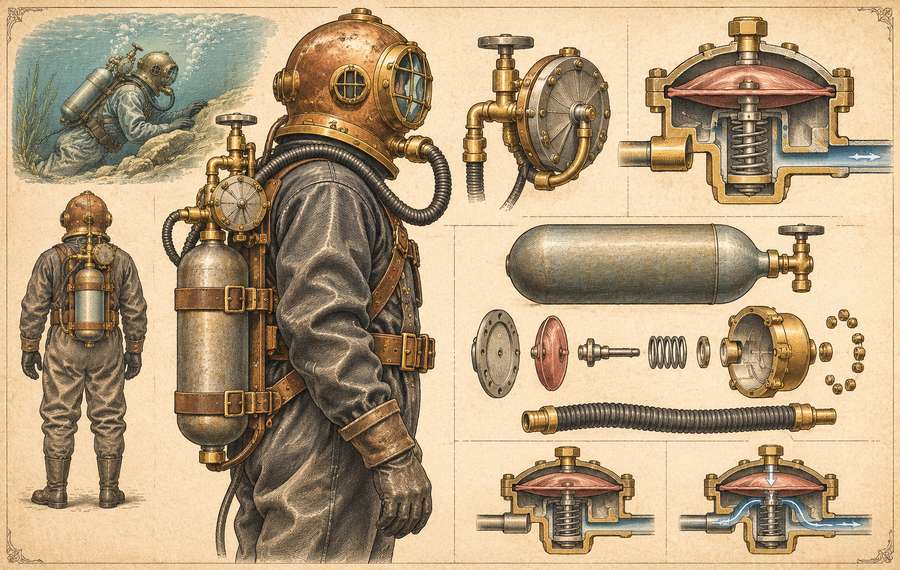
The historical significance of the Rouquayrol–Denayrouze apparatus therefore lies not primarily in its immediate practical performance, but in the technical principle it put into practice. The two inventors recognised, and applied in a working mechanism, the principle that under water air must be available automatically, adapting to the diver’s breathing needs and to the ambient pressure. Starting from the problem of mine rescue, their invention became one of the defining innovations of diving technology and created an important link between the heavy diving equipment of the 19th century and the self-contained diving apparatus of the 20th. The Rouquayrol–Denayrouze system can thus be regarded as one of the most important milestones in the history of underwater breathing.
Historical sources used: the patent-history account of the French National Institute of Industrial Property (INPI), the collections database of the French Ministry of Culture, and Philippe Rousseau’s research on the history of diving, which also draws on the data of the original patents
How did you like this entry?
No ratings yet – be the first!